
Every chapter so far has made a case for Tyrrell County. This one is the counterweight. If you are moving from a suburb — or even from the Outer Banks — the services picture here will be the biggest adjustment, and I would rather you read it plainly now than discover it in your first month. The short version: the schools are tiny, the hospitals are in other counties, the shopping is thin, and the infrastructure asks you to carry some of your own weight. Some buyers read that list and walk. The buyers who thrive here read it and nod.
One of North Carolina's Smallest School Systems
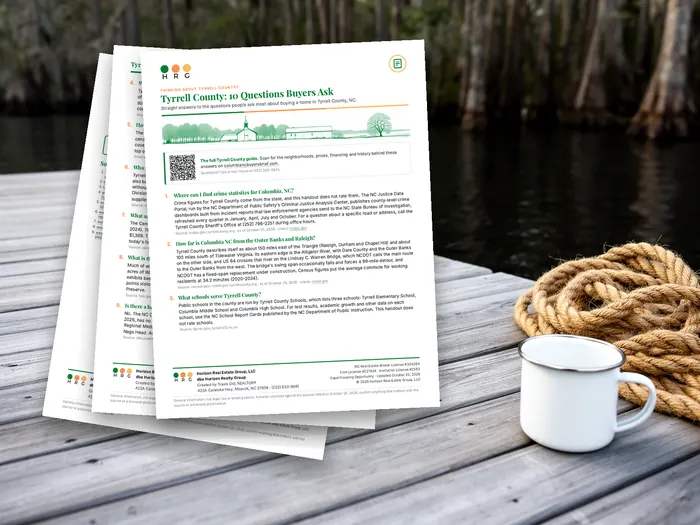
Tyrrell County Schools operates three schools serving roughly ~460 students district-wide — one of the smallest public school districts in North Carolina by enrollment, in keeping with a county of 3,245 people. That is not a typo. Some individual elementary schools elsewhere in the state enroll more students than this entire district.
The honest downside is scale: a district this size cannot field the breadth of electives, advanced coursework, athletic programs and specialized services that a large suburban district can. The honest upside is also scale: class sizes are small, staff know students by name and family, and a child is very hard to lose in a system this size. Families weigh those trade-offs differently — if school fit is a deciding factor for you, visit the schools directly and talk to the district office rather than judging from ratings sites, which handle very small districts poorly. The district's website is tyrrell.k12.nc.us.
Healthcare: No Hospital in the County
There is no hospital in Tyrrell County. Primary care exists locally, and the Tyrrell County Health Center on Bridge Street handles public health services — but hospital care, emergency departments and specialists mean a drive across a county line. Plan around these, all approximate from Columbia:
| Hospital | Location | Approx. Drive From Columbia |
|---|---|---|
| Washington Regional Medical Center | Plymouth, NC (US-64 West) | ~25 min |
| ECU Health Chowan Hospital | Edenton, NC | ~40 min |
| The Outer Banks Hospital | Nags Head, NC (US-64 East) | ~50 min |
IF DISTANCE TO EMERGENCY CARE IS A DEALBREAKER, KNOW IT NOW
For households managing a serious medical condition, response and transport times in a rural county are a real factor — not a footnote. Talk to your physician about what your situation requires before you commit to living here, not after.
Groceries and Retail: Thin by Design
Columbia covers the daily basics — groceries, fuel, hardware-store-level needs — and that is roughly the extent of in-county retail. A population of 3,245 does not support big-box stores, and none exist here. Fuller shopping runs mean Plymouth, Edenton, Washington or the Outer Banks, and most households here fold errands into other trips as a matter of routine. If Chapter 1's commute math already has you driving to Dare County for work, this matters less than it sounds; if you plan to work from home in the middle of the county, budget the drive time honestly.
Broadband: Better Than You'd Guess, But Check the Address
This is the services category that has genuinely moved. Tyrrell County has been included in North Carolina's GREAT grant broadband program in multiple rounds: Connect Holding II, LLC (Brightspeed) received a Tyrrell County award in the state's 2022 round, and in April 2025 the state announced a further Brightspeed award to bring high-speed service to 237 Tyrrell County homes and businesses — roughly ~73% of the county's 323 remaining eligible unserved locations.
Two cautions. First, grant announcements are not the same as service at your parcel — buildouts happen location by location over years. Second, coverage is address-specific in a county this rural. Before you buy with remote work in mind, check the exact address on the FCC's National Broadband Map, ask the provider directly, and ask the seller what they actually use today. Satellite service such as Starlink has become the standard fallback for parcels the fiber maps miss, and for a fully remote household it is worth pricing in from day one rather than treating as a surprise.
The Generator Mindset
Rural utility service is a long run of wire through a lot of trees in a county that catches coastal storms. Outages happen, and restoration in low-density areas can take longer than suburban customers are used to. The households that do well here plan for it: a generator (portable or standby), fuel on hand, water stored if you are on a well — because a well pump without power is just a pipe — and a freezer plan. The same logic extends to everything in this chapter. You keep a deeper pantry because the store is not five minutes away. You know a neighbor with a tractor. Self-sufficiency here is not an aesthetic; it is the operating system.
For some buyers that mindset is the whole point — it is why the homesteader archetype in Chapter 8 keeps showing up west of the bridge. If you want to see the fully committed version of off-grid coastal living, where the road itself is the beach and every house makes its own arrangements, I write about that world at the Carova Beach Brief — Tyrrell County is comfortably more connected than that, which is its own kind of reassurance.
Reading This Chapter Like a Buyer
None of the above is a reason to cross Tyrrell County off. It is a filter. The county's prices — the whole arbitrage from Chapter 1 — exist precisely because the services are thin; you are being paid, in acreage and price per square foot, to bring some capability of your own. Buyers who need suburban services at suburban distances should honor that and look elsewhere. Buyers who can carry a generator, a freezer and a 40-minute hospital drive get land and quiet that Dare County money cannot buy anymore.
Wondering If the Trade-Off Fits Your Household?
I live this market and I will give you the unvarnished version for your specific situation — schools, drive times, broadband at the actual address.
Call (252) 202-4945